The Baroque Age
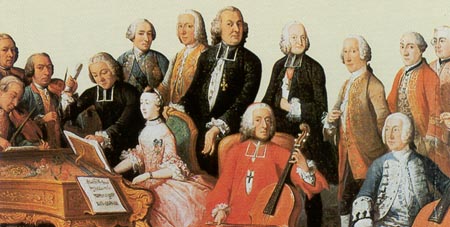
Baroque music is a style of Western art music composed from approximately 1600 to 1750. This era follows the Renaissance, and was followed in turn by the Classical era. The word "baroque" comes from the Portuguese word barroco, meaning misshapen pearl, a negative description of the ornate and heavily ornamented music of this period. Later, the name came to apply also to the architecture of the same period.
Baroque music forms a major portion of the "classical music" canon, being widely studied, performed, and listened to. Composers of the Baroque era includeJohann Sebastian Bach, George Frideric Handel, Alessandro Scarlatti, Domenico Scarlatti, Antonio Vivaldi, Georg Philipp Telemann, Jean-Baptiste Lully, Arcangelo Corelli, François Couperin, Denis Gaultier, Claudio Monteverdi, Jean-Philippe Rameau, Johann Pachelbel, and Henry Purcell.
The Baroque period saw the creation of tonality. During the period, composers and performers used more elaborate musical ornamentation, made changes in musical notation, and developed new instrumental playing techniques. Baroque music expanded the size, range, and complexity of instrumental performance, and also established opera, cantata, oratorio, concerto, and sonata as musical genres. Many musical terms and concepts from this era are still in use today.
The beginnings of Opera
In the last years of the sixteenth century, a group of musicians and literati in Florence, Italy experimented with a new method of composing dramatic vocal music, modeling their ideas after the precepts of ancient Greek theater. Their intent was that this new music should prove more direct and communicative to an audience, as the complex polyphony of the Renaissance could very often obscure the text being sung. They instead set a single melodic line against a basic chordal accompaniment, and with this notion of homophony, a new era of music began.The Florentine Camerata called this new form of musical-dramatic entertainment opera. The first operas were private affairs, composed for the Italian courts. But when in 1637 the first public opera house opened in Venice, Italy, opera became a commercial industry, and the genre in which many composers throughout history first tried out new ideas and new techniques of composition.
Styles and Forms.
- Overture – The Baroque suite often began with a French overture ("Ouverture" in French, which was followed by a succession of dances of different types, principally the following four:
- Allemande – Often the first dance of an instrumental suite, the allemande was a very popular dance that had its origins in the German Renaissance era, when it was more often called the almain. The allemande was played at a moderate tempo and could start on any beat of the bar.
- Courante – The courante is a lively, French dance in triple meter. The Italian version is called the corrente.
- Sarabande – The sarabande, a Spanish dance, is one of the slowest of the baroque dances. It is also in triple meter and can start on any beat of the bar, although there is an emphasis on the second beat, creating the characteristic 'halting', or iambic rhythm of the sarabande.
- Gigue – The gigue is an upbeat and lively baroque dance in compound meter, typically the concluding movement of an instrumental suite. The gigue can start on any beat of the bar and is easily recognized by its rhythmic feel. The gigue originated in the British Isles.
These four dance types make up the majority of 17th-century suites; later suites interpolate one or more additional dances between the sarabande and gigue:
- Gavotte – The gavotte can be identified by a variety of features; it is in 4/4 time and always starts on the third beat of the bar, although this may sound like the first beat in some cases, as the first and third beats are the strong beats in quadruple time. The gavotte is played at a moderate tempo, although in some cases it may be played faster.
- Bourrée – The bourrée is similar to the gavotte as it is in 2/2 time although it starts on the second half of the last beat of the bar, creating a different feel to the dance. The bourrée is commonly played at a moderate tempo, although for some composers, such as Handel, it can be taken at a much faster tempo.
- Minuet – The minuet is perhaps the best-known of the baroque dances in triple meter. It can start on any beat of the bar. In some suites there may be a Minuet I and II, played in succession, with the Minuet I repeated.
- Passepied – The passepied is a fast dance in binary form and triple meter that originated as a court dance in Brittany.Examples can be found in later suites such as those of Bach and Handel.
- Rigaudon – The rigaudon is a lively French dance in duple meter, similar to the bourrée, but rhythmically simpler. It originated as a family of closely related southern-French folk dances, traditionally associated with the provinces of Vavarais, Languedoc, Dauphiné, and Provence.

No comments:
Post a Comment